

Commercial Partnerships
Our partnership programme offers flexible, customisable solutions to meet you and your client bases LEI needs.

Help Centre
Find the help and support you need for your LEI from our highly trained support staff
Our partnership programme offers flexible, customisable solutions to meet you and your client bases LEI needs.
Find the help and support you need for your LEI from our highly trained support staff
LEIs are needed by legal entities engaging in regulated financial transactions. This is mandated by over 116 regulations globally. Examples of legal entities that need LEIs are funds, trusts, and insurance companies. What is an LEI?
Regulations such as MiFID II, EMIR and the Dodd-Frank Act mandate the use of LEI for legal entities falling under their scope. Find out more below.

In order to answer who needs a Legal Entity Identifier, first we must answer, why there is a need for the LEI in the first place. There has been a global need for an identifier such as the LEI for decades. As global trade increased at an exponential rate in the 1900’s, a need arose for transparency in transactions, a means of increasing trust in who you are dealing with, especially cross boarders.
There was no common identifier applicable to all legal entities across various industries, from companies, to funds and even Governments. This is why LEI codes are required.
When capital markets and banking went digital, the need for a common identifier rose again. This caused a lot of hassle with regards to identity in regulating the corporate world and financial markets. Companies owned companies that were owned by other companies and it caused a lot of confusion around who owned who, and it made it very hard in some cases to find out who you exactly were dealing with. This was the cause for many famous fraud cases and made it easy to disguise ‘dirty’ money between organisations.
History of the LEI: Following the 2008 market crash, issue with transparency in the markets caused a litany of issues with regard to identifying counter parties in transactions. When the stock market crashed, thousands of funds and trusts were unidentifiable and the fall resulted caused mass confusion. The lack of transparency put financial institutions and banks in a vulnerable position.
This was addressed at the G20 Summit of June 2011, who created the concept of the LEI. The idea was to create a digital database, of all legal entities which was easily accessible, reliable and up to date.
What is an LEI number used for? LEI Codes are simply used to identify legal entities on a global scale. This allows for great transparency in financial markets, standardisation, and greater risk control.
According to LEI ROC the LEI no. was conceived to be used by the private sector to support improved risk management, increased operational efficiency, more accurate calculation of exposures, and other needs.
One centralised source of information, that contains vast amounts of attainable, high quality data.

This also made it difficult for banks and other institutions to onboard new clients as KYC practices were relying on old and unconsolidated data.
Registry information can be hard to access and needed to be collected into a single database.
Lacking a reliable, trustworthy identifier it could become laborious and costly to onboard new clients and confirm identity (it is now estimated in research conducted by McKinsey that the LEI could save banks up to 2-4 billion Dollars annually in KYC processes).
If you would like to find a more detailed explanation of the Legal Entity Identifier System, you can read our recent post What is an LEI number?
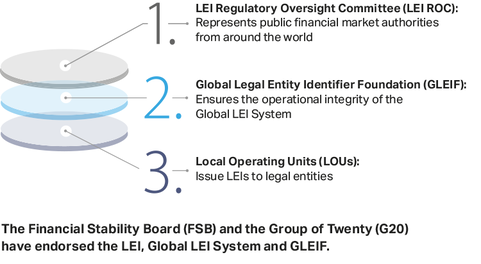
GLEIF – The Global LEI System
Regulated Financial Institutions and other regulated industries are typically required to have an LEI in order to participate in certain transactions. This includes companies that are active in capital markets, trade OTC derivatives, or engage in other regulated financial activities such as Fund administration or issuing debt. However, any legal entity, regulated or not, can obtain an LEI code…
You may be asking “do I need an LEI”? But you should also ask, “who can get a Legal Entity Identifier”? Any entity that is considered a legal entity may complete a Legal Entity Identifier application. A Limited Company, an association, a trust, a charity anything that is recognised by law to be an organisation.
However, in order to enhance transparency in the global financial ecosystem some forms of legal entities fall under the LEI number requirement (Legal Entity Identifier). The LEI requirement is a feature in many EU and Global regulations.
LEI Codes are primarily required by any legal entity who is involved with financial transactions or operating within todays financial system, especially within the US, UK or EU. There are a number of mandates currently in existence which state “no LEI, no trade”. This means if you do not have an LEI number when required, your trades will be blocked.

“(LEI) applicable to legal entities, which include, but not limited to, unique parties that are legally or financially responsible for the performance of financial transactions or have the legal right in their jurisdiction to enter independently into legal contracts, regardless of whether they are incorporated or constituted in some other way (e.g. trust, partnership, contractual). It includes governmental organizations, supranationals and individuals when acting in a business capacity[1], but excludes natural persons.”
– The International Standardisation Organisation (ISO)
Often times the LEI identifier system is used in regulatory reporting so that regulators may have an easy way of identifying counterparties to transactions.
Q: Is the LEI Number mandatory? Examples of companies that have mandatory LEI requirements, are all financial intermediaries, funds and trusts, banking institutions and financial institutions, any legal entity that is listed on a stock exchange or that issues debt, securities or equity.
Q: Do I need a Legal Entity Identifier? LEI codes are required if your legal entity falls into (but not limited to) one of the below classifications:
The use of the Legal Entity Identifier is mandatory for some companies, but others that may still apply for an LEI when not required are charities, government bodies, associations, and branches. This is quite popular as there are plenty of benefits associated with getting an LEI Number. If you fall under the LEI regulation requirement, but have not yet obtained an LEI, you may be at risk of complications with your regulators, financial intermediary or bank and could face a “no LEI no trade” ruling or a blocked/delayed transaction.

The use of LEI code as an identifier is mandated by a number of EU directives such as EMIR , MiFIR, MIFID II, SFTR & CSDR. The United States also have similar requirements such as the Dodd Frank Act, the OFR, the Federal Reserve and the Securities & Exchange commission (SEC) mandate its use in many forms and filing duties.
LEI requirements vary depending on the country, legal jurisdiction or industry. It is the prerogative of the authorities acting in individual jurisdictions to mandate the use of LEIs.
However it is up to the individual market participants to obtain their own LEI and ensure it is up to date and renewed annually. That is where LEI Worldwide can help. We can help you to renew an LEI, reactivate a lapsed LEI and transfer an LEI that is with another provider.
Try using the LEI Search tool to find your LEI, ensure it is active and if not, easily update your LEI here!
To find out if you need to have an LEI you can see this attachment which provides an overview of the official current and proposed regulatory activities which include the use of the LEI. If you have discovered that you require an LEI number for trading purposes then you can find out how to apply for an LEI Code here and you can see the documents that are required for obtaining an LEI here.

Number 9 Pembroke Street Upper, Dublin 2, D02 KR83
18 Finsbury Square Alphabeta, London EC2A 1AH
S No 203/1 PL 1/4A B12 APPT, NR UY Patil College Cinchwadgoan, Chinchwad Mulshi Pune, Pune 411033, Maharashtra, India
Official partner and registration agent to ubisecure rapidlei
LEI Worldwide facilitate entity identification in the global financial system, capital markets and private sector. We make the process accessible and simple for Legal Entities to obtain Legal Entity Identifier numbers. By doing this we help facilitate the global allocation of LEI numbers. It is our mission to be the one point of contact globally between Legal Entities & LOU’s and ensuring the LEI becomes the Worlds most important identifier.
Awards





Supported By




Payment